
Who we are
- Mahima Nayar
- Mumtaz Md Kadir
- Shahila Baharom
- Adeline Chia (ICF)
- Chia Lee (ICF)
- Clare Leong
- Eshal Mikayela
- Jamie Chua (ICF)
- Lynette Leslar (ICF)
- Masni Goh (ICF)
- Murshida Md Kadir
- Olivia Tang
- Priyadharshni (ICF)
- Priscilla Tay
- Safiah Hussein
- Shellen Fun (ICF)
- Renuka Nivashini
- Wendy Goh (ICF)
Ares Charitable Foundation
Data storytellerKontinentalist
WebsiteMarek Sajna
With heartfelt gratitudeThe research would not be possible without the 98 women who allowed us to journey with them.
Why we did it
With all the existing research on poverty and women, what was our reason for designing yet another research on lower income women. The reasons originated from the existing work done by Daughters of Tomorrow (DOT), an organization that works with lower income women in Singapore. DOT has been working to empower women through economic mobility for over a decade. We aim to facilitate livelihood opportunities for lower income women and support them in achieving economic empowerment thereby enabling social mobility for their families. We strive to enable upward social mobility for women from lower income families through upliftment of an individual’s agency.
In April 2024, we launched a one-year study with 98 women to understand what drives the constant ups and downs in their lives — and how to help them find firmer ground. We wanted to know: what kind of support actually helped women break free from poverty’s grip? Our own experience at DOT, plus research from around the world, kept pointing to two approaches — coaching and steady income support. So we set out to see what happens when lower income women in Singapore get one or the other.
We recruited women from our existing network but who are less active in DOT’s services— people who would have already known and trusted the organisation. We aimed for 100 participants (50 getting monthly cash support, 50 getting coaching) to spot real patterns without stretching our budget too thin. Practical limits shaped everything from group size to cash amounts, so we set clear guidelines for who could join.
Inclusion Criteria
- Age 18-63 years
- Women with children (maximum household size of four)
- Per capita income (PCI) equal to or below SGD 1500
- Able to work
Exclusion Criteria
- Women in DOT programs with substantial cash transfers
- Incarceration in the past 2 years
- Undergoing probation or criminal court processes
- Physical or mental health issues preventing them from working
- Retired and no longer able to work
Bringing women onboard the research programme
Our Research & Coaching tool: Family Stoplight
While figuring out who was going to be a part of the study (nature of the sample), we also had to find a way to collect data in a manner that was participative and gave primacy to women’s voices. Apart from that we needed a tool that would help in assessment of change in women’s lives. This would help us in understanding what happened because of the intervention. Family Stoplight tool is one such tool which focuses on self-assessment by participants and helps in mapping the changes in their lives.
What is Family Stoplight
The Family Stoplight tool is an adaptation of the Poverty Stoplight tool which originated from Foundacion Paraguay. This tool was adapted by DOT to make it applicable for women living in Singapore. The Poverty Stoplight, is a metric and poverty alleviation methodology that seeks to activate the potential of individuals and families to define and address multidimensional poverty in their lives using a guided self-assessment tool. Poverty Stoplight is used to support families to assess their poverty levels and identify and implement practical solutions for addressing their challenges. It is matched to the United Nation’s Sustainable Development Goals. Using this tool, families define what poverty looks like for them across six different dimensions:

The 6 dimensions are further divided into 45 indicators, adapted to the context of lowered income women in Singapore. Each indicator has the following characteristics:
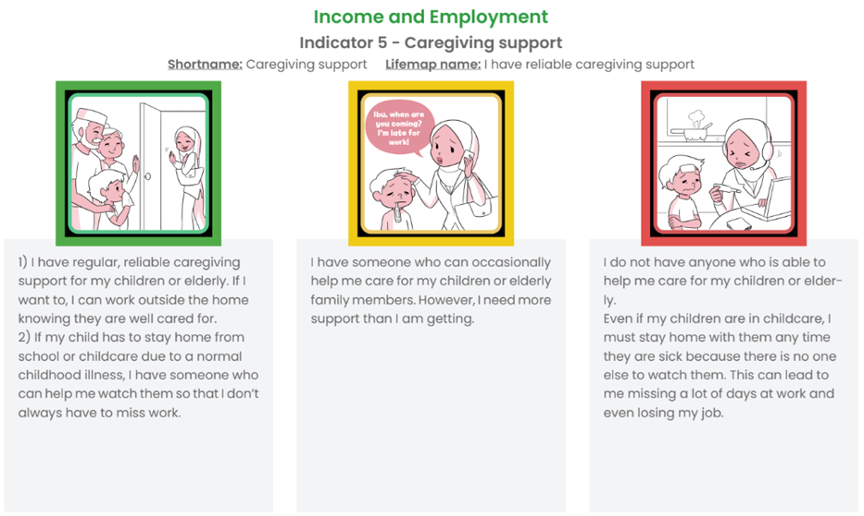
- it uses stoplight colors to indicate the range of scarcity / limitations
- it uses simple images and text to help women select which best reflects their lives
- it is actionable, achievable and aspirational, allowing women to become the central agents of their actions
| Income Support Group | Coaching Support Group |
|---|---|
|
1. Family Stoplight as an evaluation tool
|
1. Family Stoplight as a coaching tool
|
|
2. Monthly operational check-ins
Participants are required to respond to research team’s monthly check-in to confirm their income transfers, signaling that they are still in the programme. |
2. Monthly coaching check-ins
|
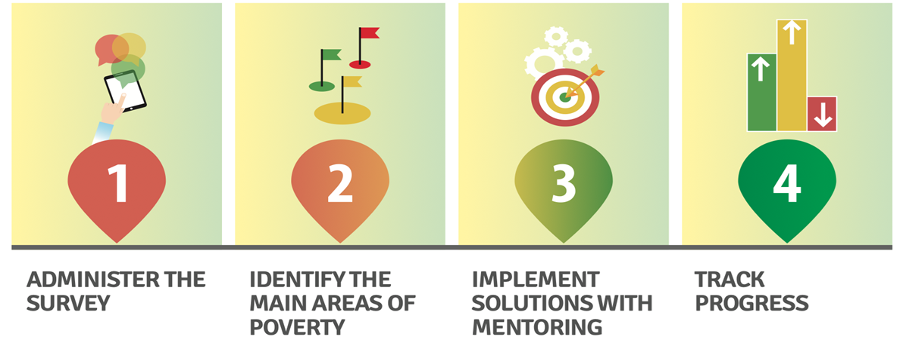
| Our client taking the survey, assisted by a coach, fills out her own Stoplight on a tablet / laptop. The role of the coach is to facilitate the survey in a language that is easily understood and that is neutral (there is no right or wrong answer). They have a dialogue about each indicator, allowing space for the woman to reflect deeper on each area of her life, and for us to understand her perspectives. | After the self-assessment of all 45 indicators, in the life map, the client can visualise her situation in a single page, enabling her to easily identify her strengths in green and areas needing improvement in yellow and red. This clear visual representation helps families understand their current situation and prioritize their efforts. | The client is able to isolate the (yellow and red) indicators that they wish to prioritise. With the help of the coach, she develops a realistic strategy to lift herself out of her key struggles by answering the three questions below:
|
The client is able to see progress each time she does the stoplight and view the colours of each indicator across time. The research team is able to track progress for each client, and also at an aggregate level for each intervention. |
Making sense of the data
The family stoplight platform is fundamentally mixed-methods by design. It collects and uses both types of data in the following ways:
(i) Quantitative data collection
In the Family Stoplight self-assessment survey each of the 45 indicators is scored as a color:
- Red: Extreme poverty
- Yellow: Moderate poverty
- Green: No poverty
This produces numerical, quantifiable data that can be aggregated and analyzed statistically to track changes in poverty levels over time. Quantitative data was analysed, with the help of visuals from Kontinentalist, through descriptive statistics (percentages, averages, or trends across each woman’s trajectory) which helped in seeing the changes that occurred in different dimensions of women’s lives.
The trends derived from the quantitative insights were used to support thematic and case story analysis in the qualitative data.
(ii) Qualitative data collection
Beyond the colored indicators, this tool also collects qualitative data by analyzing a family’s perception of their ability to change their situation and their motivation to take action. This happens through:
- Coaching: The methodology includes mentors who work directly with families to develop a “Life Map” and action plan.
- Participatory process: The qualitative data comes from the women’s own self-reflection, identification of needs, and development of solutions. For the research study, the qualitative data was collected mainly from the coaching group, as this was the group that received the coaching. The next section gives more details about the analysis of the qualitative data.
For SMP, qualitative data were largely collected from the coaching group by the coaches through interviews, regular check-ins, and their observations. They were trained in writing field notes in a format for rapid assessment provided by the research team. In this rapid assessment sheet, the coaches recorded the detailed conversations related to certain indicators, which the women emphasised. They also submitted monthly notes based on their conversations and observations of the coaching session. Coaches also submitted recordings of their session (whenever possible). The research team listened to these recordings and noted any missing data or trends in the given format.
Data was collected through different methods like surveys, follow-up interviews (methodological triangulation) at different time points (time triangulation). Different team members read the notes and heard the recordings to add to the existing field notes (investigator triangulation).
The research team members read and re-read the notes and Rapid assessment sheets multiple times to organize the raw data and then the key parts of data were categorized/ coded into concepts. Different topics were grouped together into a theme (Thematic analysis using dovetail), which helped in identifying the emerging patterns from the information collected. This step also helped in highlighting the intersectionality within data. For example, we found that health issues (of self or family members) was often one of the main factors leading to women leaving their jobs (insight #5). Thematic and case study analysis helped in discovering and describing some of the major factors that were causing disruptions in the lives of women. It also helped in understanding the factors that were providing stability in women’s lives.
For women in the income support group, interviewers made notes whenever women gave detailed explanations about indicators. These notes were organised thematically, and the similar codes and themes were added to the responses of the coaching group as well. Themes like caregiving, de-prioritisation of their own health, were responses that seemed to be coming up for both groups of women.
Reflections & ongoing learning
Respectful research requires flexible, participant‑centred methods
We learned that if research is to be respectful to participants, the process and methodology cannot be rigid. Instead, it must be able to adapt to the realities of women’s lives, recognise their time and emotional labour, and make space for their own definitions of progress. Hence, there have been a couple of instances where we paused data collection without pausing intervention, so as not to place additional stress on the clients. Also, participatory, self‑assessment tools like the Family Stoplight allowed women to frame their own priorities and experiences, deepening both the quality of the data and the dignity of the process. This dual role—supporting women’s agency while generating robust evidence—directly advances DOT’s mission and offers a useful model for other organisations seeking to embed measurement without disempowering participants.
Coaching as agenda‑free accompaniment
The programme confirmed that coaching is incredibly valuable for women who usually do not have someone to journey with them. Coaches provided a consistent, non‑judgemental space where women could reflect, plan, and troubleshoot in ways that centred their own goals rather than institutional or family expectations. This strengthened internal capacities such as planning, problem‑solving, and self‑advocacy. For DOT, this reinforces our commitment to agency‑driven support; for peer organisations, it highlights the importance of building in relational, reflective components rather than offering only transactional services.
Unconditional support can rebuild trust
A surprising finding was that women in the income support group showed improvement in their ability to trust—both in themselves and in institutions as we see an increase in help-seeking behaviour. Our reflection is that many women have internalised the belief that they only “deserve” support if they have earned it, whether in the form of money, services, or even respect. A rights‑based approach to income support flips this logic: support is provided unconditionally because human beings inherently deserve a basic level of security and dignity. This helped to reduce shame, created psychological safety, and open up space for women to focus on longer‑term decisions. It has encouraged DOT to deepen our rights‑based framing, and may be instructive for other organisations considering unconditional or low‑conditionality support models.
Individual interventions have limits without structural change
Despite the benefits of coaching and income support, women’s stability remained vulnerable to systemic factors—especially caregiving responsibilities, health shocks, and rigid or unsupportive workplace practices. These pressures often outweighed individual efforts, leading to disruptions in employment or income even when women were motivated and engaged. This has clarified that DOT’s mission cannot be fulfilled through individual‑level interventions alone. We now see more clearly the need to pair direct services with advocacy and partnerships focused on caregiving support, healthcare access, and fairer workplace norms. For other organisations, this underscores the importance of designing programmes that are realistic about structural constraints and, where possible, contributing to system-level change.
Investing in frontline capacities and longitudinal learning
The mixed‑methods, longitudinal design showed that social mobility is non‑linear and fragile, rather than a simple “before and after” story. Following women over a year, and investing in coaches’ capacities for documentation and ethical, trauma‑sensitive practice, gave us a more accurate picture of how gains, setbacks, and shocks interact. This has led DOT to refine how we define and track “success”, moving towards indicators of stability, resilience, and agency over time. It also highlighted the importance for DOT—and other organisations—of resourcing staff development and longer‑term learning, even within modest budgets.