
Key insights and data highlights
How can we build a more stable future together
How can we build a more stable future together
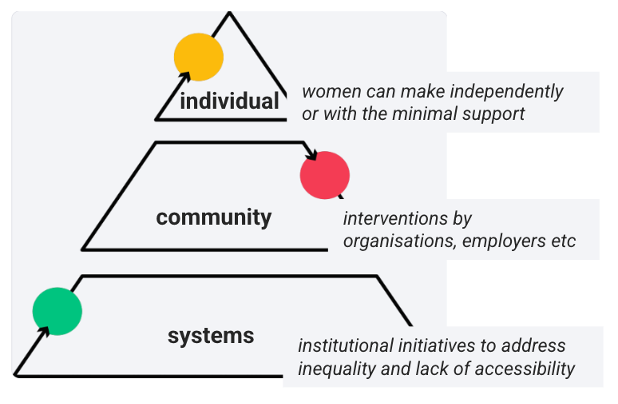
Insight #10: Opportunities to improve stability for lower-income women have to be multi-faceted and targeted, focused on economic, social and psychological wellbeing. They can be taken at the individual level (improvements that women can make independently or with the support of their social network), societal level (interventions by the organisations, employers, etc.) and at the systemic level (higher-level initiatives to address inequality and lack of accessibility).
Income support is as crucial as coaching support in ensuring stability in women’s lives.
Individual level: we see women diversifying their sources of income to create more economic stability in their lives. This can take the form of having some form of financial assistance to supplement their income from employment, or taking on additional flexible or home-based work to have a side income (if they are not limited by time).
Societal level: Loans and credits, such as this particular research initiative, has been proven to be beneficial. Women have used the income provided to finally make that doctor’s visit, to tide over unexpected health emergencies, or for the benefit of their children (to name a few). More importantly, it has also given them more mental bandwidth (“peace of mind”) to rest and plan for the future.
Systemic level: Reliable and transparent financial assistance at the state-level remains important. This is because some women will not be able to work full-time when they have caregiving responsibilities that will not disappear for many years, especially if they have children with special needs. When women go back to work, financial assistance may still be needed in the initial transition period so they are not suddenly overwhelmed by the increased financial responsibilities, which may create more instabilities in their lives.
Caregiving support is another area of importance. The social construction of care work has been shaped by gender norms that position women as the primary caregivers within both the household and society. This gendered expectation has placed a disproportionate burden on women, limiting their economic opportunities and social roles.
Individual level: Women balance caregiving support with their partners and the help of their family members, which requires them to maintain good relationships and communication with their network.
Societal level: Not all women can, or want to, depend on their social network for caregiving because it can cause undesired expectations and frictions in the relationships. Hence, interventions such as childminding, and caregiving funds which DOT offers can go a long way. Accessible initiatives are needed, both at the social sector level and at the workplaces, to ensure that caregiving support is embedded better into the society and will not be dependent on women’s social relationships alone.
Systemic level: For our society to be more equitable, we should foster a culture that values care work as essential labor, deserving of tangible recognition and support. Doing so will re-examine traditional gender norms and promote gender equality in both paid and unpaid work. Some examples are cash assistance, flexible schedule, and leave policies for caregiving. For longer term intervention, recognising unpaid caregiving in retirement schemes can ensure that women age with dignity even if their work history is affected by family responsibilities.
Workplace support is needed if we want to see lower income women sustaining longer in their jobs. Women have quoted that empathetic and good relationships with their supervisors and colleagues are what motivates them to stay in their jobs, as these facilitate a flexible working arrangement that meet their needs. On the other hand, misunderstandings and tension amongst colleagues tend to be the reason that women leave or are unhappy at work.
Individual level: Women need to see the importance of building professional relationships at work, and communicating their needs better. They should also understand the importance of work culture in the job-seeking journey.
Societal level: Organisations can curate workshops focusing on soft skills at work, such as professional communication, negotiation at work, how to handle conflict, communicating your needs, etc. Employers should also implement safe and fair working conditions.
Systemic level:Flexible working arrangements and inclusive hiring practices should be encouraged so that employers are incentivised to offer them. It will also help to integrate mothering responsibilities more broadly into social norms.
Healthcare can be more accessible to women in various types of employment, and the use of medical benefits should not be penalised.
Individual level: Women have to gain more awareness of what is in their employment contract, including what is not covered so that they can plan to seek coverage through private insurance (if affordable, or over the longer term)
System level: Setting guaranteed minimum benefit levels (a social protection floor) and legally mandating universal coverage helps ensure consistent and adequate access for all women, regardless of occupation, income, or employment type.