
Key insights and data highlights
What made a difference for women in the programme
Insight #4.1: Consistent income transfers, with minimal requirements have contributed to stability in women’s lives. Some of the biggest changes over the one-year period were seen in Caregiving and Trust. Other substantial increases are in health indicators, comfortable home, happiness, debt, ability to generate income and mentorship at work.
An indicator that saw a big increase is Trust. This indicator sees the highest percentage in the yellow zone across both groups, suggesting that this is an area that can be improved on amongst the lower income population as whole. Women who grapple with trust issues, particularly with authority figures in government services /organizations, at work or within their families, often find themselves financially constrained. In such cases, income support provides a vital safety net, helping them resist the control that these authority figures typically exert through financial dependence.
Furthermore, receiving consistent, and timely incentives without any questions asked may have also contributed to the increase in trust.The criteria to receive the monthly income transfer is transparent, minimal and clearly communicated since the start of the research. Many women mentioned the fact that receiving the $400 at the end of each month meant that they had peace of mind the following month. Erica had specifically said “It allows me to breathe.” This can also explain the improvement in the indicator on Trust.
The biggest improvement in the income support group is in Caregiving. While some women did report using the money on student care, and school transportation, there isn’t any other information to suggest why caregiving has seen a big jump.
The income support group saw a reduction in numbers of women reporting “struggling” in the health indicators. This coincides with women reporting that they have used the additional money in health issues that have been troubling them (see insight #5).
Similarly, indicators in Home and Environment increased in the “going well” section, as women reported that they have used the money for home repairs and furniture that they have not been able to afford previously.
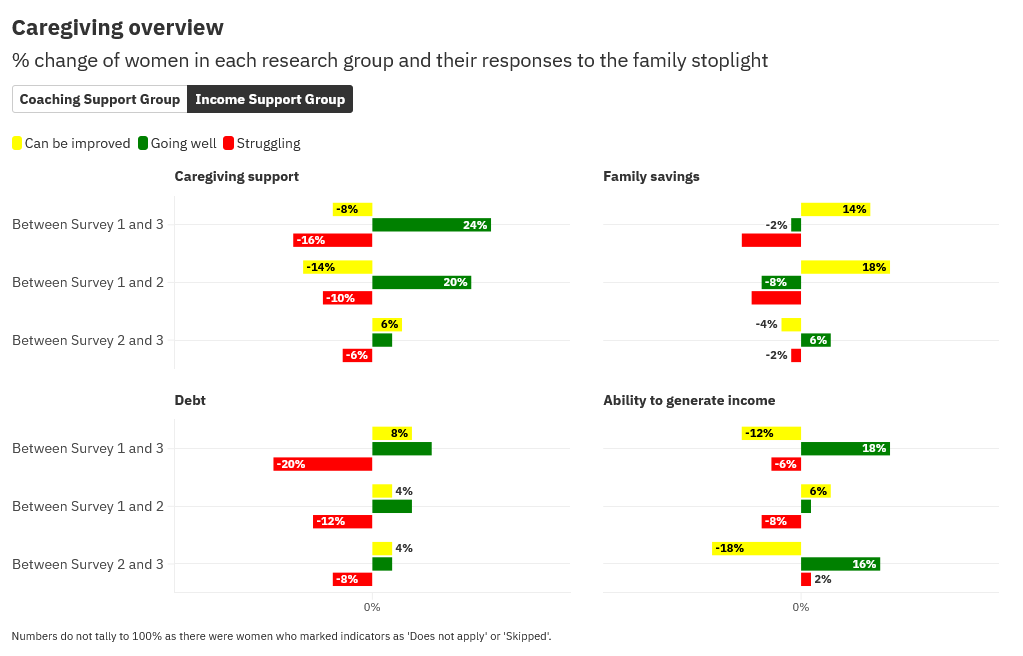
Insight #4.2: However, the income support provided was S$400, and may not be sufficient to overcome systemic/structural challenges. It is to be noted that all these indicators, barring mentorship at work, saw an eventual drop off, pointing to the need for more long-term, and higher-levels of support.
For example, average scores for Caregiving support reported one of the largest increases, especially between Survey 1 and 2, but dropped off considerably between Survey 2 and 3. This may be due to various reasons – some surveys done during the school holiday period where women have higher caregiving needs, the lack of sustainable caregiving support as most of it is reliant on having good social relationships, or the inability to pay for, or get a slot, for paid caregiving options.
The benefits of the income support may get absorbed into urgent and/or emergency expenditure. This includes a health crisis, sudden unemployment, debt repayment, extra expenses during school holidays, and house upgrades that have been delayed. This gives very little room for women to use the income support for longer-term benefits, including sustainable upskilling for income generation, caregiving arrangement and saving plans—three indicators that have been identified as priorities by women receiving the other intervention (coaching).
Inflation was also a big problem locally and globally from 2024 to 2025. This watered down the real/material benefits it could make to lower income women’s lives, especially so in families with more complex issues.
For example, many women are oftentimes reluctant to visit the doctor not just because of immediate healthcare costs, but also because of the opportunity cost as multiple medical visits can impact their caregiving responsibilities, and their employment which exacerbates time poverty.
Women in less stable employment situations use the income support as a cushion when they are hit with a short-term crisis not allowing them to earn an income, but does not solve the root of the problem, which is that the employment situation isn’t sustainable even though it fits women’s short-term need for flexible work arrangement. This is especially true for women with freelance or contract work which do not provide paid leave, and women who have been working multiple jobs to make ends meet while sacrificing time for themselves and/or their families.
