
Key insights and data highlights
What made a difference for women in the programme
Insight #3.1: Coaching support directly impacts psychological stability which plays a key role in enabling women to stay motivated. This is evident in the change in indicators linked to Interiority & Motivation between the start to end of the one-year period.
The greatest changes that were of significant margins (30% and above) were in Interiority and Motivation for women in the Coaching Support group. This shows the benefits of coaching clearly.
With better psychological stability, women are able to set priorities that may have been harder for them to select initially, such as home ownership. For example, One woman picked domestic violence (with regard to relationship with her daughter) as a priority in time point 3, when her I&M indicators are all green. This is the only time dv has been prioritised in the study.
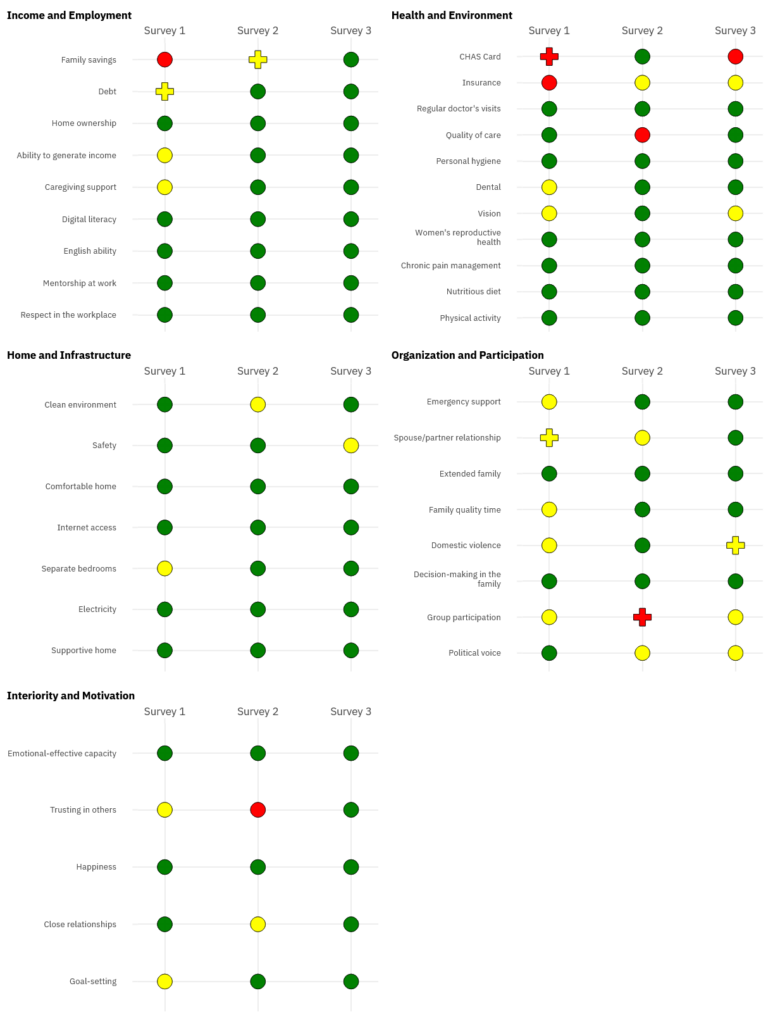
Insight #3.2: Women in the Coaching Support group also experienced improvement in other dimensions, such as indicators linked to Income & Employment. This is because coaching helps women identify their priorities and set achievable, manageable goals based on their desired areas of change. This personalised approach allows women to take charge of their development and increases their accountability, leading to greater stability.
Some of the most prioritised indicators were Family Savings, Debt, Caregiving Support, and Women’s Reproductive Health. Homeownership remains a key priority for many women too. In survey 1, many reported that they have not been able to achieve it because of the lack of stable income or citizenship issues. By survey 3, while this reason is still listed, another reason that is causing a delay in women owning a home is the complicated process that they find hard to navigate.
These indicators that were most prioritised showed some of the biggest improvements for indicators in both groups, but more so for the Coaching Support group.
Many also reported feeling more able to trust others and sustain close relationships, as coaching helped them navigate difficult dynamics with family members or employers. It also enabled them to draw on these networks for social support, which is reflected in improved indicators such as access to emergency help and stronger partner relationships under the Organisation and Participation dimension.
Insight #3.3: While coaching contributed to stability in some aspects, these changes did not always translate into improvements across all areas, nor were they always sustained over time. This suggests that while coaching plays an important role, it may not be sufficient on its own to ensure long-term stability for lower-income women.
In some instances, women may not have the mental bandwidth to think about goals amidst overwhelming responsibilities across caregiving, work and finances. Sometimes, creating the time and space for coaching, with the guide of someone consistently there, helps them to move in that direction. At other times, the issues women face are beyond coaching, and they may need more specialised intervention. In such instances, coaches may delay surveys and/or priority setting while providing referrals to more effective interventions such as counselling.
Persistent barriers that coaches noted as something requiring more intervention include issues of domestic violence, death/major health issues in family and challenging relationships with children due to behavioural issues.
Other persistent issues that saw priorities being chosen across multiple surveys by the same women are Family Savings, Debt, Women’s health and Home Ownership. This signifies systemic barriers that are harder for women to transcend simply through coaching, as it requires broader / higher-level interventions.
Coaching Profile
T lives with her husband and daughters aged five and three years old. She has been working steadily in a full time job with a supportive employer. T has faced complex trauma. She lost her parents before the age of 21 and found out that she was adopted only after mother’s death. She had depression and suicidal ideation related to authoritative parenting restricting her life choices related to education and even moving out of the house unsupervised. After the death of her parents, circumstances led to her having to leave the house and marry her current husband.
Areas of concern / priorities
T identified financial stability and pain management as her main areas of concern. During initial sessions she focussed on how she was providing support to her marital family and downplayed her own concerns. Over time as rapport was built with the coach, other complex issues came up during the sessions. T went through tough pregnancies as well as multiple abortions (surgical and medical). She faced several health issues due to this. Caregiving was also challenging as she had to frequently change child minders because of daughter’s behavioural issues. She revealed that her relationship with husband included frequent arguments even in public spaces. She has experienced domestic violence (causing physical injury) but she did not seek medical treatment. Communication with husband is poor but there are times that she values his presence. She experiences ongoing emotional distress, depression, frequent anxiety attacks as well as self-harm episodes. She has limited support networks therefore husband becomes the main source of support.
Support Provided
T’s history of unstable relationships meant that trust building with her took some time. She was given the space to bring up issues which she was comfortable sharing and the initial focus was on financial stability. With increased rapport and revelation of core issues, the intervention shifted to supportive work and empathetic understanding of the participant’s situation.
Outcome
With complex trauma issues coaching during the one year span was focused on trust building by providing a non-judgemental holding space for T. While coaching attempts at rebuilding self-esteem and boundaries, T was encouraged to seek help from specialised mental health services.