
Health worries make sustaining a job hard
Faith's story
Faith is a 31-year-old single mother raising three children on her own—a teenage son, another in early secondary, and a four-year-old daughter. Life hasn’t been easy, but she has built resilience out of necessity.
Multiple employment
Faith’s employment journey has been marked by a mix of persistence, instability, and the struggle to balance survival with personal aspirations.
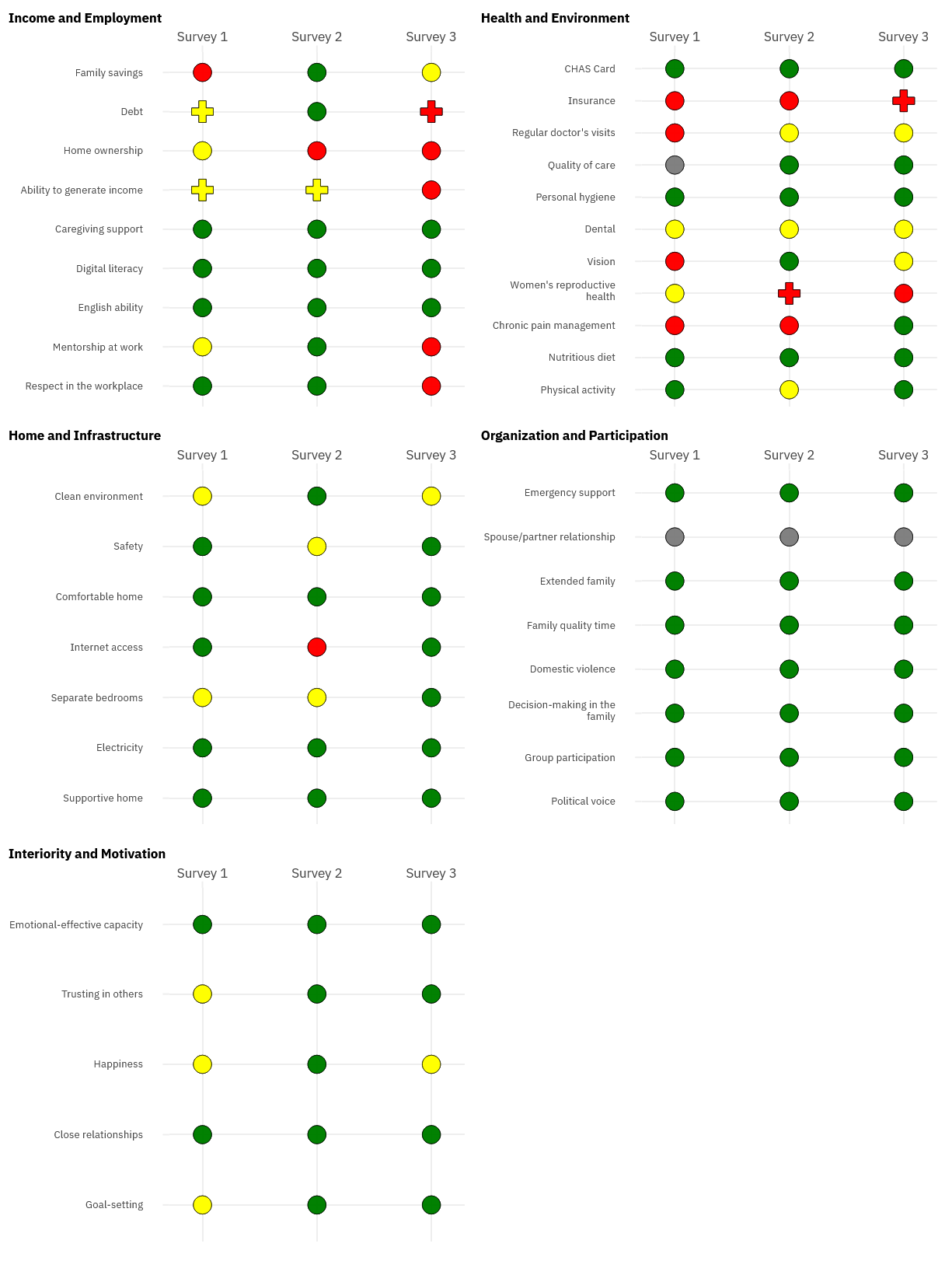
She has long relied on her small side business as a henna artist. The business is competitive, and though small, it gives her pride — it’s hers. She has even started using Instagram and digital tools to market her work, surprising herself with how quickly she learns. During festive and wedding seasons, her income rose temporarily from about $150 to $500 a month. She actively promoted herself using Instagram and even explored digital tools like ChatGPT for marketing ideas. Yet she knew the income wasn’t enough for the family’s stability, and her lack of formal qualifications—“I don’t have a diploma”—made her feel restricted in other job opportunities.
To secure steadier earnings, she holds a formal job alongside her small home business. Over the course of the one-year research, she has worked three formal jobs. The first is at a food stall, which came to an abrupt end when the stall-owner decided not to continue renting the stall. She immediately started searching for a new one at another eatery that provided a higher pay. However, she faced conflicts with the management over an issue about scheduling and quit within two weeks. In the end, she returned to a previous contract job with SATS. She liked the people there and appreciated the flexibility, although the downside was that being a contractor came with no CPF, leave, or bonuses.
Faith continues to search for better employment opportunities. She admitted that while she had dreams of more stable office work, realistically, she knew her work history in food and beverage and kitchen roles meant she would likely only get jobs in that sector. She continues looking for full-time work but remains open to part-time arrangements to keep her small business alive.
Adding to her challenges is her complicated relationship with financial aid. Although her income hovered between $500 to $1,600, she did not apply for ComCare support. She had stopped years ago when her youngest was a toddler, believing she had a responsibility to work and support her family independently. Yet she also confessed that the application process was too invasive: too many questions, too little privacy, and too little understanding of her situation. She thought, “I can manage if I work hard enough.”
Social support reduces her burden
Despite the instability, she draws strength from her family. Her mother offers caregiving support, often watching the children when Faith’s work schedule gets chaotic. The boys sometimes stay at their grandmother’s place when things are especially tough, giving Faith a little space to breathe and plan her next steps.
Managing her health, one step at a time
Her health has been another battle. She faced frequent abdominal pain that disrupted her daily life, but she hesitated to seek treatment. The thought of hospitals—and the costs—made her anxious. Eventually, she saw a doctor who suggested possible causes, but the uncertainty still lingers. She continues pushing through the pain while caring for her children. Still, there are bright spots. Recently, she began intermittent fasting to feel healthier.
What keeps her going…
When asked about her life, Faith doesn’t sugarcoat it. Some days, it feels like too much. Other days, she finds comfort in small wins—like her kids laughing together during dinner, her children settled in school supported by friends and teachers, or a customer sending her a kind note about her henna designs.
Through coaching, she has learned some skills to reduce feeling overwhelmed – journaling, considering what areas are within her control, and taking small steps to move forward – “I know how to plan, I can list down what I want to do next. It is always better to start small than not start at all.”
Key areas of stability:
- Social support that provides dependable caregiving when needed
- Motivation to keep her small business going, and to be financially independent
- Skills to get her a formal job
Key areas of instability
- Lack of job opportunities beyond that in F&B
- Accessing avenues to pursue her dream of being a small business owner
- Managing finances across multiple employment, while still caring for her own health