
Stories from the women we walked with
Tanya's story
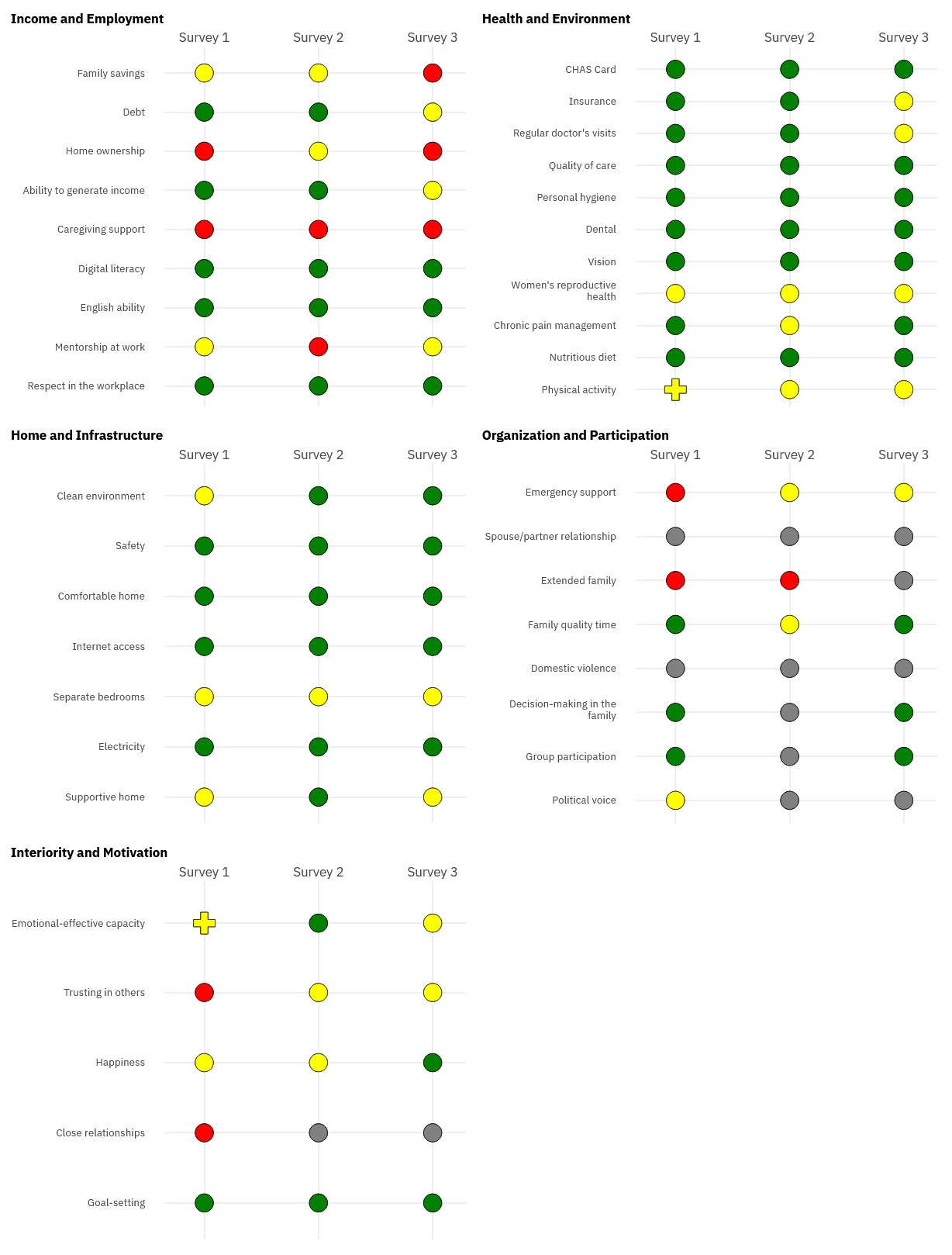
Tanya is a 35 year-old mother to three children – two sons aged 12 and 9, and a daughter who is 6-year-old. With minimal family and social support, caregiving takes centre-stage in her life as she tries to fit employment opportunities, skills training, and her me-time, around it. Due to this, her journey towards her aspirations has been something like a shifting goal post – changing depending on her children’s needs and her left-over bandwidth after that.
Multiple employment to make ends meet
She works as a baker on weekdays, bringing home $1,000 each month. On weekends, she takes on part-time work in a restaurant kitchen and occasionally behind the bar. She has to as her children depend on her.
Tanya is not just a hardworking mother, she’s a skilled and respected worker. In the F&B industry, she’s known for her reliability and excellence. “A lot of people want me,” she says, “but I can’t work past 7pm because I have to fetch my daughter.” At times she feels her colleagues are taking advantage of her part-time status, often pushing additional responsibilities onto her or expecting her to compress more work into her limited hours.
Halfway through the study, Tanya changed her job from a baker to a part-time chef because it offered a better salary. However, the cycle of being overqualified and obligated to assist her colleagues and superiors happened again. Tanya ended up working longer hours even when she was unwell. “My boss was the only one in the kitchen and he really needs help so I force myself to come but I feel really bad about it”. She is constantly looking for other opportunities to find the right fit.
She’s turned down managerial positions and full-time roles simply because she can’t commit to evening hours. “If someone could take care of my kids, I could earn a lot more.” Still, she doesn’t let her limitations define her. She’s constantly upgrading her skills and learning on the job. During the second survey, she shared that she has enrolled in a nutrition and fitness course to work towards her dream of becoming a nutritionist. Her coach recommended her to the Upskilling Fund that DOT provides, to ease her financial burden for upskilling. However, she ended up missing the final exam as she was seriously ill during the school holiday period, at which time the caregiving burden tend to be higher. Retaking it would cost USD100—money she couldn’t spare. Reluctantly, she made the decision to not continue with the course for now.
The unpaid labor of mothering
Having come from a difficult childhood, Tanya wants to provide a better life for her children. “I don’t treat my children the way I was treated,” Tanya says. Her parenting style is deliberate, nurturing, and grounded in empathy. Tanya ensures her children are exposed to activities from community organizations such as Beyond Social Services during their holidays, keeps communication open, and brings them out on weekends.
Her love for them is what keeps her going. However even that has limitations given her situation. “Singapore food is so expensive and everytime have to pay for three and end up spending $100 plus. That is more than I am earning in a day. I feel bad for not bringing them out everyday” But Tanya is unable to afford it.
Her children have learned to be independent out of necessity. The two sons cook, clean, and care for their little sister when their mother is at work. This is what allows Tanya to work on weekend and weekday nights (outside of their schooling hours).
Her youngest daughter still needs to be fetched from school, a daily responsibility that limits how long Tanya can work. There’s no one else who can do it. In her absence, she leans heavily on her eldest son, who, despite being only 12 and dyslexic, has taken on the role of a parent.
When any of the children are sick, it’s her eldest who stays home, missing school so his mother can go to work. Her second son, just 9, supports his older brother with schoolwork—because Tanya, juggling multiple jobs, simply doesn’t have the time to do so herself.
Options such as student care is an added financial stress. She had applied for student care for all three children but they charge a fee of $600 per child. This is a lot more than the previous student care ($150 for each child) that the children were in which unfortunately closed down. Although she had managed to secure her daughter in a student care, her two boys are left unattended at home and this has caused other issues to surface.
Both boys have been suspended from school—her eldest for absenteeism, and her second son for disciplinary issues and was asked to pay $200 for breaking a classmate’s spectacles. “They get bored at home and stay up all night,” Tanya says. “Then they can’t function in school.” Tanya wishes to place them in activities such as Taekwondo but will require more spending and is something she cannot afford. Without proper caregiving support that is affordable and accessible, her sons may be at risk of other ill-behaviours in the future.
Lack of extended network
Tanya had a difficult childhood herself—her father passed away when she was young, and by 16, she was living independently. She describes her relationship with her mother and sisters as strained and emotionally distant. Her siblings criticize rather than support her, often comparing her life to theirs. At one point, her sisters reported her long work hours to her ex-husband instead of offering help. That moment marked a turning point and she cut them out of her life. As a result, support from her family is non-existent. “They never came to help with the children. They just judged me,” she reflects.
She is in contact with her ex-husband but their communication is tense. He is also not a reliable caregiving support. “Only comes whenever he feels like it. One month can come two times, another month can come four or five times,”
With no one to rely on for caregiving support, Tanya feels it most during difficult times such as when she fell sick. She feels no one cares enough to ask her how she is coping and it makes her feel alone. The emotional weight of being unsupported, especially when she’s unwell, takes a toll on her mental health. With no afforded time and space to recover, Tanya shuts down and this has been detrimental to other aspects of her life.
During the year-long research programme, Tanya built a strong, supportive relationship with her coach from Daughters of Tomorrow. What was a tough relationship at the start became a relationship that extended beyond the research study—they even went on an outing together with their children. Her coach also linked her to resources related to employment, housing schemes for potential home ownership, and alternative caregiving options. For the first time in a long while, Tanya allowed herself to be supported.
A Tired Body, But an Unbreakable Spirit
Tanya’s situation is delicate. Her days are long and her responsibilities unending. But what keeps her going is clear: her children. She wants them to have a better life than she did—a life with opportunity, stability, and love. She is also one with the potential to excel in her career, if she is able to rely on consistent support that she can entrust her children with.
Key areas of stability:
- Have the skills and experience to get/sustain a job, and even perform in her career
- Actively pursuing skill upgrades and career development
- Deep commitment to children’s well-being, despite limited resources
- Led by her many aspirations, both for herself and her children
Key areas of instability
- Lack of reliable caregivers
- Face a big issue of time poverty, which ends up with her sacrificing on better opportunities for herself (e.g. skills upgrading, job promotion) as well as her mental wellbeing (highly insufficient rest, and me-time)
- Lack of reliable social network for tangible social and emotional support
- Difficulty in seeking help, and tendency to rely only on herself